

Goal Setting Tips: 7 Traps & Tips for Goal Setting
Millions of people set ambitious goals every year, but many feel stuck weeks later. The problem isn’t a lack of effort or motivation. The issue is deeper and stems from psychological traps that quietly sabotage even the most powerful goal-setting impulses.


Perfectionism, overthinking, fear of failure, and dopamine-driven distraction hijack your ability to follow through. That’s why traditional advice like “just stay disciplined” rarely works. In this guide, you’ll discover how your brain resists change and how to apply essential tips for effective goal setting that properly align with human psychology.
Why Standard Tips on Goal Setting Fail: The Psychology of Getting Stuck
Most tips for goal setting focus on what to do. You’ve definitely come across recommendations that you should write your goals down, visualize success, and stay consistent no matter what. But they ignore the deeper question – why your brain resists action in the first place. Human behavior is driven more by emotion and survival wiring than by logic.
Your brain is designed to avoid uncertainty, conserve energy, and seek instant rewards. Long-term goals activate fear and delayed gratification. The human nervous system naturally resists such things. This is why even smart goal setting tips fail when they don’t account for stress, self-doubt, and emotional overload.
Without addressing these internal blocks, even the best plans collapse under procrastination and self-sabotage.
7 Psychological Traps & Essential Tips for Effective Goal Setting to Fix Them

Each of the seven traps you’re about to explore targets a different mental pattern that quietly kills momentum. These traps affect anyone pursuing personal growth, no matter how motivated they feel.
Some people decide to add more pressure to overcome blocks, but this strategy rarely yields the desired outcome. In this case, it is paramount to apply personal goal setting tips that work with your brain’s natural wiring. Thus, you’ll be able to transform intention into consistent and sustainable action.
Perfectionism convinces you that if you can’t do something perfectly, you shouldn’t start at all. Instead of protecting your standards, it quietly destroys your consistency.
Research shows that maladaptive perfectionism is linked to higher anxiety, lower self-efficacy, and chronic procrastination. Your brain associates action with judgment and threat, activating the amygdala (fear center). This triggers avoidance instead of progress. You don’t delay because you’re lazy. You delay because your nervous system is overwhelmed by impossible standards. Fortunately, here are some helpful goal-setting tips to use.
What to do:
- Set “minimum viable goals” (e.g., 10 minutes instead of 1 hour).
- Track completion, not quality.
- Normalize imperfect action as part of growth.
When your brain feels safe from judgment, it finally allows forward movement.
Has it ever happened that you felt a surge of motivation, set massive goals, and believed that this time everything would be different? Then reality hit, and the cycle collapsed.
False hope is fueled by dopamine instead of a well-thought-out strategy. Your brain overestimates future motivation and underestimates future resistance. Studies show people consistently misjudge how hard change will feel emotionally and physically. This leads to unrealistic expectations, rapid burnout, and a crash in self-trust.
What to do:
- Break big goals into friction-sized steps.
- Attach goals to specific behaviors, not outcomes.
- Build in recovery time to avoid burnout.
When goals fit your real human limits (not your ideal self) you stop quitting on yourself.
You overthink every decision, research endlessly, and still feel unable to choose. Motion feels risky, while thinking feels safer.
Anxiety overloads the prefrontal cortex, reducing decision-making clarity. When too many options exist, the brain defaults to freeze mode. Traditional tips on goal setting ignore anxiety’s role in mental shutdown. In the end, you stay trapped in your head instead of moving forward.
What to do:
- Limit options to 2–3 choices max.
- Decide based on direction, without chasing perfection.
- Externalize your thoughts instead of looping internally.
Stuck in your head? Talk it out with AI to find clarity instantly. Attainify’s AI Voice Coach helps you verbalize confusion, regulate anxiety, and regain momentum through guided reflection, without pressure.
Your brain craves instant rewards, but your goals pay off later. This creates a brutal motivation mismatch.
Dopamine spikes from immediate pleasure (scrolling, snacks, or entertainment). Long-term goals offer delayed dopamine. When the reward is far away, motivation drops fast. This is why consistency collapses after the initial excitement fades. So, it is important to stick to weekly goal setting tips.
What to do:
- Design weekly “wins” instead of distant milestones.
- Celebrate effort, not just results.
- Stack rewards directly after hard actions.
When your brain gets frequent feedback that effort = pleasure, discipline no longer feels like punishment.
You avoid fully committing because failing would confirm your worst self-doubts. So, you stay in “almost trying” mode.
Fear of failure activates the same neural pathways as physical danger. Your brain treats mistakes as social threats, which can be a loss of status, rejection, and shame. To protect you, it pushes avoidance and delay. Fortunately, there are several proven career goal setting tips that can help you overcome the fear of failure.
What to do:
- Redefine failure as data, which doesn’t define your identity.
- Set learning-based goals instead of performance goals.
- Practice “exposure to failure” through small risks.
Growth only becomes possible when your brain feels safe enough to try and fail on purpose.

It frequently happens that people try to change their behavior without changing the space around them. They rely on motivation while their environment quietly pushes them in the opposite direction.
Behavioral science shows that up to 60–70% of daily actions are habit-driven and triggered by environmental cues. Your brain is constantly responding to what’s visible, easy, and familiar. Clutter, noise, notifications, and social pressure drain cognitive resources and increase decision fatigue. In chaotic environments, even the best goal setting tips 2026 collapse because your brain is overwhelmed before action begins.
What to do:
- Make good behaviors visible and easy.
- Make distractions invisible and inconvenient.
- Attach goals to specific locations (desk = work, bed = sleep only).
When your environment supports your intentions, you don’t need heroic motivation. You get consistency by default.
You believe that discipline alone will carry you through. When willpower fades, you assume something is wrong with you.
Willpower operates like a finite battery. If you’ve ever checked Trinity Health Club goal setting tips, you know it drains under stress, poor sleep, emotional strain, and decision overload. Studies on self-regulation confirm that relying purely on force leads to rebound behaviors, especially with food, exercise, and habits. This is why most goal setting tips for weight loss fail after the first burst of motivation.
What to do:
- Automate meals, workouts, and routines.
- Remove friction before temptation hits.
- Pre-commit to actions in advance.
Willpower is a limited battery. Don’t rely on force. Use Attainify’s Daily Action Plan to automate the next step.
Advanced Goal Setting Tips for Specific Situations
Not all goals live in the same psychological environment. Your brain behaves differently at work, in school, and during personal change. That’s why generic advice often fails in real life. Advanced goal-setting tips adapt to the emotional pressure, time constraints, and identity challenges of each situation.
Below, you’ll find targeted suggestions for different groups of people who try to battle various challenges. These frameworks align with how your brain actually works, not how motivation books assume it should.
Work goals fail when they clash with burnout and unclear expectations. Constant digital overload also takes a toll on your results. Most employees don’t struggle with ambition, but they grapple with mental fatigue and shifting priorities.
Effective employee goal setting tips focus on clarity and recovery.
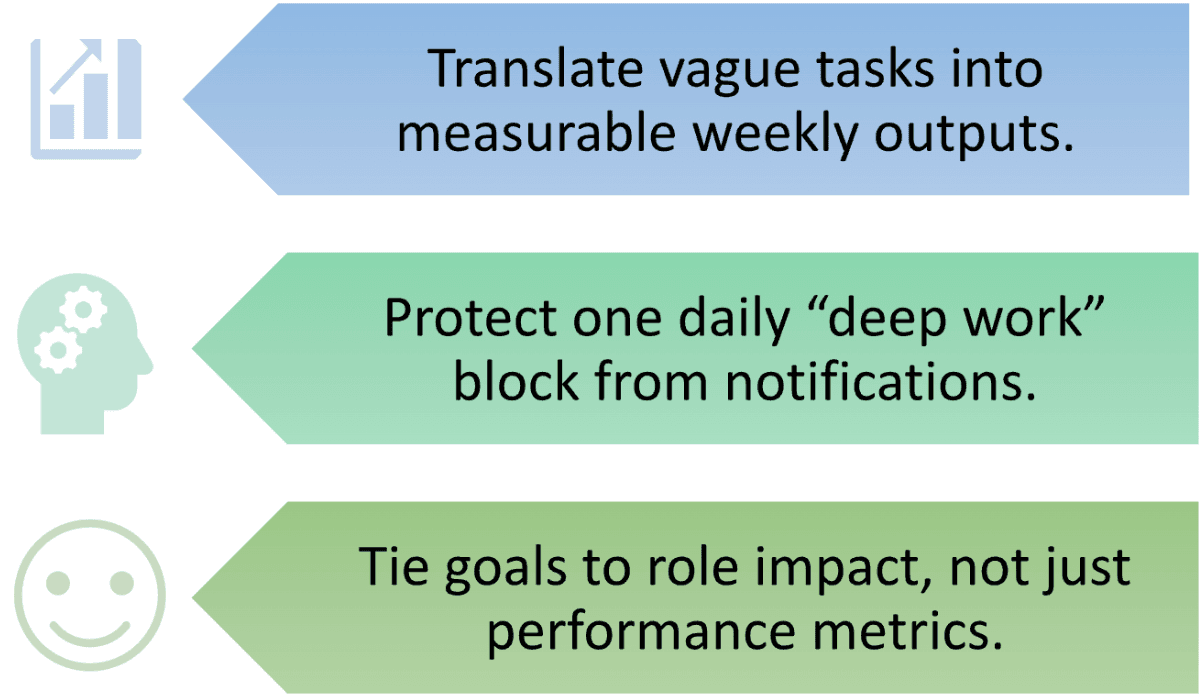
From a neuroscience perspective, clear goals reduce cognitive strain and decision friction. This keeps the prefrontal cortex engaged instead of overwhelmed. When work goals feel specific and psychologically safe, execution rises naturally, without pushing harder.
Students battle a unique mix of pressure, fear of failure, and dopamine addiction from constant digital stimulation. To manage constant distractions and still be productive, take advantage of these science-backed goal setting tips for students:
- Study in short, high-focus intervals (25–40 minutes).
- Separate identity from grades to reduce performance anxiety.
- Create visible progress trackers for motivation feedback.
When studying becomes emotionally safe and visibly rewarding, procrastination loses its grip. Execution improves not through pressure, but through neurological alignment.
Goal Setting Tips 2026: Automate Success with Attainify
The future of consistency is tied to automation. In 2026, the most effective goal setting tips no longer rely on memory, discipline, or willpower alone. They hinge upon intelligent systems that guide action before resistance appears.
Attainify transforms abstract goals into daily executable steps through:
- AI-generated action plans
- Adaptive habit tracking
- Real-time emotional support via voice guidance
Instead of asking, “What should I do today?”, you can clearly see your next step.
FAQ
You should focus on small, consistent actions rather than massive transformations. Science shows that habits form through repetition and emotional safety, not pressure. That’s why breaking goals into weekly steps, tracking progress visually, and reducing friction in your environment work better than pure motivation.
It is necessary to track where you repeatedly get stuck. Such patterns as perfectionism, avoidance, emotional eating, overthinking, or quitting early reveal the specific trap at play. Reflection journaling, behavior tracking, or guided AI coaching can uncover these patterns faster.
Such tips work because your brain stays motivated by short feedback loops and visible progress. Yearly resolutions fail due to delayed reward and emotional burnout. Weekly goals create frequent dopamine reinforcement, flexibility, and faster course correction. So, your momentum is alive instead of fading after January.
Surely. Attainify is especially effective for implementing employee goal setting tips in real work environments. It translates large professional objectives into daily executable actions while adapting to workload and mental state. With AI-driven planning and voice-based clarity support, employees reduce overwhelm and improve consistency.
Sources
Nubmered list here
Nubmered list here End



Related Articles